Stop hiring engineers to clear your backlog.
Agents plan the ticket, write the code, fix CI, and open the PR. You approve the plan. You approve the merge. Your senior engineers stop babysitting branches and get back to design work.
Claim your early access
You're hiring engineers to clear a backlog that grows faster than they can ship it.
Velocity drops and you can't tell why. The roadmap slips and the team says it's a tooling problem and a hiring problem and a process problem.
obx ships the backlog with agents and an approval gate. You see every plan, every PR, and every dollar before it lands.
Every step is recorded: the plan, the prompts, the tool calls, the outputs. Open any task and walk it back to find where a decision was made or where it went wrong.


Plan
Every task starts with a written plan you read first. The agent says what it will do; you approve, send back changes, or reject.
Nothing gets built until you sign off.

Build
Approved plans become code that follows your team's conventions: how you write, how you test, how you commit.
The plan names the rules it's following so anyone can see what changed and why.

Review & Ship
A PR opens. Tests run. A second agent checks the code against your rules, fixes what's broken, and reruns until the PR is ready to merge.
You see the finished work, not every step along the way.
Your tools, your flow.
obx slots into the pipeline you already have, from idea, to ticket, to code.
Specs, briefs, the rough shape of what to build.
e.g. Notion. Bring your own doc tool.
Concrete tickets the team and obx can pick up together.
e.g. Linear. Or Jira, GitHub Issues, the one you have.
Pull requests, reviews, merges. Where the work lands.
e.g. GitHub. GitLab and Bitbucket work the same way.
Swap any of these for the tool your team already uses. obx adapts to the pipeline; the pipeline doesn't adapt to obx.
What you get back.
Three outcomes a founder can quote on Monday.
Speed
Tickets become merged PRs without waiting on a senior engineer's calendar. Cycle time shrinks because the agent never queues.
Throughput up; headcount flat.
Control
You approve the plan before a line is written and the merge before a line is shipped. Every prompt, run, and dollar is on the page.
Nothing surprises you on Monday.
Leverage
Your seniors stop babysitting branches and start designing the next thing. Each engineer ships more without doing more.
The team scales; the payroll doesn't.
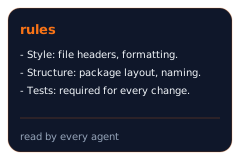
obx reads your repo's rules before it writes a line.
Style, structure, test patterns, commit conventions. The plan it posts cites which rules it's applying.
TODAY
Plan, build, review, ship.
Tickets in. Reviewed PRs out. Costs metered.
ROADMAP
Operate
Deploy automation, on-call, incident response. Not yet shipped.
Claim the backlog you stopped shipping.
Drop in a repo and a few tickets. We'll send back reviewed PRs in a week. You approve every plan. You approve every merge.